

Hard
Given n non-negative integers representing an elevation map where the width of each bar is 1, compute how much water it can trap after raining.
Example 1:
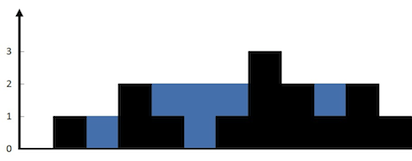
Input: height = [0,1,0,2,1,0,1,3,2,1,2,1]
Output: 6
Explanation: The above elevation map (black section) is represented by array [0,1,0,2,1,0,1,3,2,1,2,1]. In this case, 6 units of rain water (blue section) are being trapped.
Example 2:
Input: height = [4,2,0,3,2,5]
Output: 9
Constraints:
n == height.length1 <= n <= 2 * 1040 <= height[i] <= 105
To solve the "Trapping Rain Water" problem efficiently, you can use a two-pointer approach. Here are the steps to solve the problem:
-
Initialize Pointers:
- Initialize two pointers
leftandrightat the two ends of the arrayheight.
- Initialize two pointers
-
Initialize Variables:
- Initialize variables
max_leftandmax_rightto keep track of the maximum height encountered from the left and right sides, respectively. - Initialize a variable
waterto store the total trapped water.
- Initialize variables
-
Iterate Through Array:
- While
leftpointer is less thanrightpointer, do the following:- If
height[left]is less than or equal toheight[right]:- Update
max_leftto the maximum ofmax_leftandheight[left]. - Add
max_left - height[left]towater. - Increment
leftpointer.
- Update
- Else:
- Update
max_rightto the maximum ofmax_rightandheight[right]. - Add
max_right - height[right]towater. - Decrement
rightpointer.
- Update
- If
- While
-
Return Result:
- After the loop ends, return the total trapped water.
class Solution:
    def trap(self, height):
        n = len(height)
        left, right = 0, n - 1
        max_left = max_right = 0
        water = 0

        while left < right:
            if height[left] <= height[right]:
                max_left = max(max_left, height[left])
                water += max_left - height[left]
                left += 1
            else:
                max_right = max(max_right, height[right])
                water += max_right - height[right]
                right -= 1

        return water

# Example Usage:
solution = Solution()

# Example 1:
height1 = [0,1,0,2,1,0,1,3,2,1,2,1]
print(solution.trap(height1))  # Output: 6

# Example 2:
height2 = [4,2,0,3,2,5]
print(solution.trap(height2))  # Output: 9
This code defines a Solution class with a trap method to compute how much water can be trapped after raining in the given elevation map represented by the array height. The example usage demonstrates how to create an instance of the Solution class and call the trap method with different inputs.